The Power in Your Hands, 2nd Edition - Updated and Revised
From résumés to research papers, The Power in Your Hands teaches teens to write clearly and convincingly—with all four nonfiction modes, a witty tone, and zero need for micromanaging.
$65
Quantity:

Complete Course
Consumable

Faith-Based
In a Curriculum Kit

2026 Eleventh-Grade Curriculum Kit
The Power in Your Hands, 2nd Edition - Updated and Revised
The Power in Your Hands: Writing Nonfiction in High School is a one-credit high school writing course that teaches teens how to write clear, effective nonfiction. Covering exposition, persuasion, description, and narration, the course provides step-by-step instruction for 22 essays and reports across 117 lessons.
Your teen will learn persuasive writing, research writing with MLA citations, literary analysis, comparison essays, how-to writing, and more. Along the way, he'll analyze both student and professional writing samples, strengthen his editing skills, and gain confidence as he develops his own writing style.
The course teaches teens how to improve their own writing. Instead of relying on a parent to point out every weakness, your teen learns to evaluate, revise, and strengthen his work independently—a skill that pays off far beyond high school.
Written in a conversational, engaging style, The Power in Your Hands provides plenty of guidance without feeling overwhelming. Clear instructions and practical examples help teens understand not just what to write but why strong writing works.
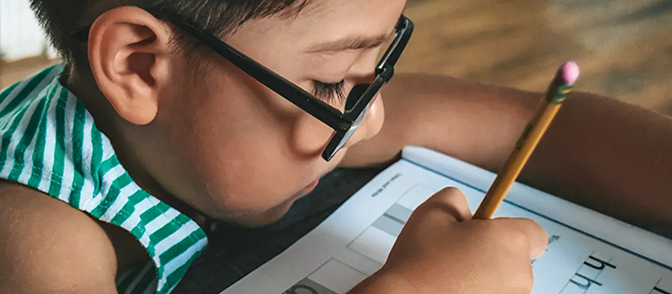
Designed for self-directed learning, the course walks your teen through each assignment with detailed explanations and manageable steps. The accompanying Teacher's Guide includes grading rubrics, answer keys, writing schedules, and daily "Power Surge" prompts to help generate ideas when the blank page feels intimidating.
How to Use Power in Your Hands
- Plan on completing 3 to 4 lessons each week. With 117 lessons total, this pace allows your teen to earn a full high school writing credit over a typical school year.
- Make sure your teen completes the writing assignments, not just the instructional lessons. The course includes step-by-step guidance for 22 essays and reports, and the real growth happens through the writing itself.
- Encourage him to use the "Be Your Own Editor" checklist throughout the writing process. One of the strengths of this course is that it teaches teens to evaluate and improve their own work before turning it in.
- Use the Teacher's Guide to simplify grading. Rubrics, answer keys, and suggested schedules help you assess assignments consistently without spending hours reviewing every paper.
- When your teen needs help getting started, use the "Power Surge" writing prompts. These short exercises are designed to generate ideas, warm up reluctant writers, and overcome writer's block.
- Save completed assignments in a writing portfolio throughout the year. Not only does this provide documentation for the course credit, but it also creates a valuable record of your teen's progress as a writer.
In the 2026 kits this course earns high school credit:
1 credit of Composition II
Language Arts · 11th grade · Classic kits
- The Power in Your Hands (Student Text)
- The Power in Your Hands Teacher's Guide
PUBLISHER'S INFORMATION
Publisher: Berean Builders Publishing IncAuthor: Sharon Watson
Age/Grade Recommendation: Age 14+/9th Grade+
Lessons: 117
Faith-Based: Yes
Consumable: Yes (Student Text), No (Teacher's Guide)
Format: Softcover
Size: 8.5" x 11"
Made In: USA
Copyright: 2025
Edition: 2nd Edition, Updated and Revised
Student
ISBN/Barcode: 9781971136844
Page Count: 419
Teacher's Guide
ISBN/Barcode: 9781971136851
Page Count: 203

review by Mommy Octopus
”I have been very pleased with The Power in Your Hands and other programs by Sharon Watson. I plan to continue using them with my students each year. Depending on how you use it, The Power in Your Hands can be spread out to 2-3 years! I love curriculum that lasts a while!”
Read the ReviewFind answers to the most frequently asked questions about this product below:
Typically counted as 1 high school credit.
<h4>The Power in Your Hands, 2nd Edition, Updated and Revised </h4>
<h2>Question: Is the Updated and Revised edition, ISBN 978-1-971136-85-1, compatible with the original Power in Your Hands, 2nd Edition?</h2>
The short answer: It might be troublesome to use both editions in a co-op or family situation, but not impossible. Most pages have no changes at all. <br><br>
We recommend the <i>Updated and Revised Edition</i>, however, as it contains the latest and most modern wording, examples, and essays.<br><br> The following are changes to the <b>textbook</b>:
<div class="black-bullets">
<ul>
<ol> In “Persuasion: Logical Appeal,” we updated some examples in lesson 5 for in-text citations.</ol>
<ol>In “Persuasion: Compare and Contrast,” lesson 5 has a new “digging deeper” essay. Instead of reactions to religious symbols, the new topic is on two ways doctorassisted suicide is viewed: compassionate versus dangerous. </ol><ol>In “Persuasion: Moral/Ethical Appeal,” lesson 1 contains new examples for the active voice.</ol> <ol>In “The Position Paper and Documentation,” lesson 1 is expanded to help students select reputable sources for their information. This additional information <b>changes all the page numbers after page 229</b>; therefore, original versions of The Power in Your Hands, 2nd Edition will be off one page from the updated and revised version.</ol> <ol>We updated the documentation methods in lesson 7 and 8 of that chapter to align with the Modern Language Association’s latest methodology.</ol> <ol>In “Biographies” lesson 4, we changed the second method of writing a biography.</ol> <ol>Throughout the “Compare and Contrast” chapter, we deleted references to World War I and World War II and substituted references to modes of communication: in person or electronically. The example essay in lesson 2 is new.</ol> <ol>In “Personal Narrative,” the example essay is different from the original one.</ol> <ol>Throughout the textbook, there are small revisions to wording that will not have a negative effect on students using both books in a co-op.</ol><ul></div>
The <b>Teacher’s Guide</b> includes new information about what students are learning in each lesson and what terms are being taught. For instance, in lesson 4 of “Persuasion: Emotional Appeal,” we’ve added “<i>Students are examining examples of loaded words.</i> <b>Terms:</b> connotation, denotation.”<br><br> Updated March 2026
- 1Easily keep track of daily work with newly numbered lessons.
- 2Teens learn common grammar mistakes (7 lessons).
- 3The emotional appeal speech is shorter and easier to understand.
- 4Students can look up items in the new index.
- 5Grading essays just got a lot easier! Specific grading grids in the Teacher’s Guide are designed for each essay assignment. Parents have asked for this, and these grids will make grading student essays MUCH easier! Download the first one here.
- 6The chapter on the old SAT essay has been removed. Find info on that essay here.
Though much of the material has not changed, the page numbers have. In addition, the example speech for an emotional appeal has changed, along with all the work associated with it. Therefore, the two editions are not compatible.
The Power in Your Hands is for students in grades 9-12. Younger students will be frustrated with the material and will be better served by Jump In, which is for grades 5 - 8.
High-school students will learn writing skills that they can use for the rest of their lives. These include brainstorming, organizing their thoughts, using appropriate point orders, citing sources, introduction and conclusion know-how, proofreading, writing for a specific audience, and much more. In addition, they'll learn how to write in all four modes of nonfiction writing: persuasion, exposition, description, and narration.
This practical textbook includes specific instructions for writing at least twenty-two essays and reports and includes focused checklists for each assignment. Some of the assignments include the logical appeal, the moral/ethical appeal, process or how-to writing, a research paper with documentation, comparison and contrast, a literary analysis, descriptive essays, and much more.
The Power in Your Hands has been specially engineered for beginning writers and college-bound writers. How is this possible? Sharon Watson is experienced in teaching writers at all skill levels, and she brings her expertise to this curriculum. Beginning writers will quickly catch up with their age-mates and gain confidence to tackle the chapters. The incremental, conversational, practical text will equip them for school or professional writing. Experienced writers will learn new material early and be challenged by the Digging Deeper sections found throughout the text.
Absolutely. Here's how:
- 1When public and private schools give a writing assignment, the students do their work at home and still have classes during the day. This schedule is not necessary in homeschools. You can assign the essay at the end of the chapter and then follow the suggested writing schedule. The daily tasks in the schedule can be done during your normal writing-class time. The book will last for two years with this schedule, and your student won't feel hurried (and neither will you)!
- 2The Teacher's Guide contains a fun program called 14-Minute Writing Surges. These writing prompts cover fiction and nonfiction writing for the school year. You can use this program for a whole year before or after you use The Power in Your Hands, or you can take a break from the textbook for a few days or weeks by using the Writing Surges. It's a fun way for your student to write on an interesting topic without being evaluated on everything he or she writes.
- 3If you combine numbers 1 and 2, you can use The Power in Your Hands for three years. This will give your teens a thorough knowledge of the material at a leisurely pace.
- 4Many parents have successfully used another option. They work through the first 13 chapters in the first year, stopping the year after writing the position paper, and finish the course the next year. This seems to be a sensible pace for most families.
We suggest completing the following chapters in The Power in Your Hands as a bare minimum:
- Chapters 1-4
- Chapters 9-10
- Chapters 11-13
- Chapters 17-19
- Chapter 20
- Chapter 23
These will give your student a wonderful foundation for writing. If you have time, you can add in other chapters of interest to your student.
If your child does only the chapters listed above, he will want to be sure to read through the other ones, especially the Grammar Factoids and the Toolbox portions that usually appear in the beginnings of the chapters. These portions are important to writing and are referred to in later chapters and on the checklists that correspond to the assignments.
You spoke and we listened. The 2nd Edition of the Teacher’s Guide contains new, easy-to-use grading grids for every essay assignment. You can download a sample here.
Additionally, the Teacher’s Guide contains a grading section with real essays and their explanations tucked into “How to Earn an A,” “How to Earn a B,” and so forth.
I always give two grades: one for content and one for grammar/mechanics. This gives a clearer picture to students about their progress and areas of strength or weakness. You may want to adopt this method as well. All the new grading grids (except for the sample) reflect the two-grade method.
Yes. Be Your Own Editor, a one-page proofreading tool, teaches students how to catch their own mistakes by asking the right questions. Much time is spent in the textbook showing students how to proofread. In addition, they are asked to evaluate professional and student writing, which gives them a keener eye when evaluating their own work.
Also, in the 2nd Edition, students grapple with common grammar mistakes in a new chapter of that title.
The Power in Your Hands can be used successfully in co-ops, private schools, and homeschools.
Humor has been scientifically proven to alleviate fear and engage the more creative parts of the brain. The Power in Your Hands sometimes uses humor as a teaching ally. It is surprising to observe how quickly and completely students lose their fear of writing after they've written on the topic of why teachers should not give homework!
Thinking deeply about and writing about the complex political, social, environmental, religious, and other issues of our day is important. Some of the assignments reflect this need. However, making students write about issues while they struggle with the structures of writing is akin to throwing an aspiring athlete into the game before he or she has learned how to play. This textbook focuses on students learning, practicing, and perfecting the writing skills they'll need for the rest of their lives.
The Power in Your Hands, 2nd Edition - Updated and Revised counts as 1 credit of Composition II on a high school transcript. To turn its grade into a GPA, use our free homeschool GPA calculator: it works out each letter grade from your student's scores, figures the GPA by year and for all of high school, and prints a grade record for the transcript.