Friendly Biology - Nonreligious Worldview
Friendly Biology makes high school science clear, doable, and yes—actually enjoyable. With vivid visuals, kitchen-table labs, and 28 well-paced lessons, it turns reluctant learners into confident biology students.
$99.95
Quantity:

Please note: The video license is designed to accompany the course text, and is not a stand-alone curriculum. The audio and video portions of this course are non-refundable.

2026 Ninth-Grade Curriculum Kit
Friendly Biology Set
Biology is the study of life, but that doesn't mean it has to feel overwhelming. Friendly Biology breaks complex topics into manageable lessons, helping teens build a solid understanding of living systems through clear explanations, engaging examples, full-color illustrations, and hands-on activities.
Created by a homeschooling husband-and-wife team, the course covers the major topics typically found in a high school biology curriculum, including cell structure, mitosis and meiosis, genetics, taxonomy, ecology, protein synthesis, human body systems, and human reproduction. Over 28 structured lessons, your teen builds a broad foundation in biology without feeling buried in scientific jargon.
Visual learners will appreciate the abundance of diagrams, photographs, and illustrations throughout the course. Even challenging concepts are presented in a straightforward way, making it easier for teens to connect new information to ideas they already understand. And yes, the occasional Lego figure makes an appearance to help explain particularly tricky topics.
The labs are designed with homeschool families in mind. Most activities use common household materials, and some experiments are even edible. Easy to implement yet academically meaningful, the labs reinforce key concepts while helping teens experience biology firsthand.
The set includes a full-color textbook, a consumable student workbook with two worksheets per lesson, and a Test and Answer Key booklet with multiple-choice assessments. Printable PDF versions of the tests are also available for added convenience.
Friendly Biology is commonly counted as one high school biology credit and offers a thorough introduction to life science for teens who benefit from clear instruction, steady pacing, and practical application.
Want to make the course even more independent? The optional Friendly Biology Video License allows author Joey Hajda to teach the material directly while your teen follows along in the text. The publisher describes the videos as the "teacher" and the textbook as the "classroom book," making the video license a valuable support for families balancing multiple students or teens who learn best through direct instruction. Please note that the video license is not a stand-alone curriculum and requires the Friendly Biology text.

See some sample pages from this series and browse all that it has to offer.
How to Use Friendly Biology
- Plan on completing one lesson each week. With 28 lessons total, you'll finish with time to spare for review, makeup work, or the inevitable interruptions that come with a school year.
- Begin each lesson by reading the corresponding section in the textbook. The clear explanations, full-color illustrations, and diagrams provide the foundation for everything that follows.
- Next, complete the workbook activities. Each lesson includes two worksheet sets designed to reinforce vocabulary, review important concepts, and strengthen comprehension.
- Finish the lesson with the corresponding multiple-choice test from the Test and Answer Key booklet. Printable PDF versions of the tests are also available if you prefer a separate testing format.
- Set aside time for the lab activities as they appear. Most experiments use common household materials, making them easy to implement while still providing meaningful hands-on reinforcement of the concepts being studied.
- No microscope is required, yet your teen will still explore topics such as cell structure, genetics, taxonomy, ecology, human body systems, and human reproduction through a combination of reading, activities, and labs.
- If you're teaching more than one teen, consider adding an extra workbook since the textbook and test booklet are reusable.
Follow the course as written, complete the labs, and maintain a steady pace throughout the year. By the end, your teen will have earned a full high school biology credit and developed a solid foundation in life science.
In the 2026 kits this course earns high school credit:
1 credit of Biology
Science · 9th grade · Non-Religious kits
- Growing a Pet Potato Plant
- In Quest of Carbon: Marshmallow Incineration
- Testing for the Presence of Amylose (starch)
- Behavior of Lipids (fats)
- Making Butter
- Actions of Enzymes on Proteins
- Testing pH using Red Cabbage or Blueberry Juice
- Making Homemade Yogurt
- Making Cheese
- Osmosis using Chicken Eggs
- Osmosis using Fresh Veggies
- Creating a (functional) Cell Model
- Using Homemade Playdough to create a Mitosis Model
- Building a DNA “Ladder"
- Growing Edible Mushrooms on Toilet Paper (supplies purchased separately)
- Flower Dissection
- Dissections of Fresh Specimens are presented by video (available separately).
Publisher: Friendly Chemistry & Create Space
Author: Dr. Joey Hajda & Lisa B. Hajda
Age Recommendation: 14+
Grade Recommendation: 9th+
Faith-Based: No
Lessons: 28
Copyright: 2019
Made in: USA
Student Text
Consumable: No
Lessons: 28
ISBN: 978-1545277355
Pages: 464
Format: Softcover
Student Workbook
Consumable: Yes
ISBN: 9781544623078
Format: Softcover
Lesson Tests and Answer Keys
Consumable: Yes
ISBN: 9781539670797
Format: Softcover
Video License:
Access: Unlimited viewing via online portal with no expiration date. An internet connection must be available for viewing.
License Covers: Current student and immediate family members. Co-op licenses are available from the publisher.
Audiobook License:
Access: Text read verbatim by author, Joey Hajda, accessed via online listening portal.
Lesson 14 Notes
Lesson 14 in Friendly Biology introduces how living things have been divided into various groups and subgroups (which is known as taxonomy). When Friendly Biology was written in 2012, Lesson 14 utilized The Catalogue of Life website to illustrate many of the concepts found in the lesson. Since that time, The Catalogue of Life website has been changed, and it no longer corresponds to the images used in Friendly Biology. We suggest that you utilize Lesson 14 as written and not expect to find similar screens on The Catalogue of Life website. Instead, following completion of the lesson, we encourage you visit The Catalogue of Life website to learn more about taxonomy and how the database can be useful for further study.
Click here to see a sample of Lesson 1: Characteristics of Living Things (PDF)
Click here to see a sample of Lesson 2: A Little Bit of Chemistry (PDF)
Click here to see a sample of Lesson 3: Carbohydrates (PDF)
Click here to see a sample of Lesson 4: Lipids (PDF)
View a video sample from Friendly Biology
View a video sample from Lesson 10: Chromosome Duplication
View a video sample from Lesson 22 (Part 2): Heart Dissection Video
View a video sample from Lesson 21 (Part 1): Body Systems of Movement
Click here for a Lab Supply List PDF
Click here for a Biology Lab Report Template PDF
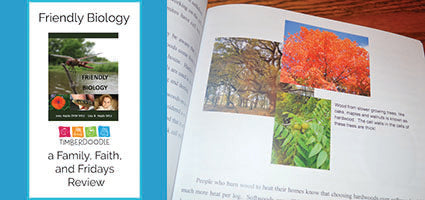
review by Family, Faith, and Fridays
”I am confident Friendly Biology will prepare my son for higher level sciences while allowing me to maintain my sanity! It's a win- win for all!”
Read the ReviewFind answers to the most frequently asked questions about this product below:
Yes! You can record this as a lab science course on your student's high school transcript if they complete the labs.
Yes! The family license does not expire.
Yes, the Friendly courses will be adequate. However, if your student will be going into a science-intensive major and career, they may benefit from (and enjoy) a more intensive science course.
No, you need the text to accompany the video course. The publisher likes to consider the video to be like the "teacher" and the textbook to be like your required classroom book.
Friendly Biology (Christian Worldview) acknowledges God as the creator of all living things. Friendly Biology (Nonreligious Worldview) does not mention God.
Both versions discuss currently accepted observations of living creatures in today's world. The theory of evolution is not mentioned at all in either version.


- June 8, 2026
twoblue30
Wasn't very pleased with this product. It was not geared for 10th graders. My daughter learned most of the things in the curriculum well before 10th grade. There were a lot of mistakes in the book also!