Science Lessons and Investigations - Grade 1
From shadows to seeds, your first grader investigates 14 NGSS-aligned mysteries—experimenting, reading, and building vocabulary while exploring animals, plants, light, sound, and patterns in the sky.
$23.99
Quantity:

Science Lessons and Investigations - Grade 1
Shadows that grow and shrink. Strings that vibrate and hum. Tiny seeds that become towering plants. In fourteen NGSS-aligned units, your first grader becomes the scientist, exploring questions about the world through observation, experimentation, and discovery.
Each unit begins with a question worth investigating, followed by a hands-on activity that encourages your child to explore the concept firsthand. Short readings with vivid photographs introduce key ideas, new vocabulary expands scientific understanding, and a concluding activity helps bring everything together.
Along the way, your child will track the sun, moon, and stars, discover what plants and animals need to survive, and investigate sound, light, and communication. Teacher support pages and a complete answer key make it easy to guide the learning while keeping the focus on curiosity and exploration.

See the first 8 pages of this book to browse all that it has to offer.
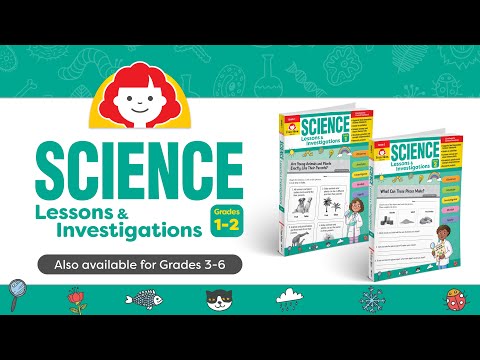
This robust teaching resource gives you everything you need, including:
- Teacher support pages and an answer key
- Unit concept page to guide discussion
- Vocabulary/Words to know
- Reading selections with real-life visual examples
- Comprehension and vocabulary activities
- “I wonder” and/or research and write writing prompts
- Hands-on science investigations that include science experiments, STEM challenges, observations, art projects, and other creative cross-curricular activities to enhance learning
Topics covered in Science Lessons and Investigations Grade 1 include:
Life Science
- How Do Animals Use Their Body Parts?
- What Parts Do Plants Have and What Do They Do?
- How Do Body Parts Help Animals Grow and Survive?
- Do Animals Have Babies?
- Do Plants Have Babies?
- Are Young Animals and Plants Exactly Like Their Parents?
- Do Animals from the Same Species Always Look the Same?
- Do All Roses Look the Same?
Earth Science
- Can We Predict Patterns for the Sun, Moon, and Stars?
- Can We Predict the Pattern of the Seasons?
Physical Science
- What Happens When Materials Vibrate?
- What Happens When There Is No Light?
- Where Do Shadows Come From?
- How Do We Communicate Over Long Distances?
Publisher's Information
Publisher: Evan-Moor Educational Publishers
Age Recommendation: 6
Grade Recommendation: 1st
Faith-Based: No
Consumable: Yes
Pages: 224
Units: 14
ISBN: 9781645140030
Format: Softcover
Copyright: 2020
The Science Lessons & Investigations series uses the 5E model—five simple steps that turn science into discovery.
- Engage – Start with a quick hook: a question, photo, or short activity that gets kids wondering and making predictions.
- Explore – Let him try it. Your child will investigate, test, and observe before anyone gives away the "answer."
- Explain – Your child shares what he's found, then you connect his discoveries to the right science words and concepts.
- Evaluate – Check for understanding with a drawing, a short explanation, or another quick task that shows what he's learned.
- Extend – Wrap it up by applying the concept to something new—maybe an experiment, model, or real-world problem.
It's a simple structure that keeps science active, interactive, and rooted in real thinking.

Review by One Luckey Wife:
”This science curriculum goes over quite a bit: animals, plants, earth science and physical science.”
Read the Review
Review by The Coulter Coop:
”Today I’m sharing a full look into the Evan Moor Science Lessons and Investigations Grade 1 book...”
Read the Review

Customers earn Doodle Dollars for reviewing products they've purchased, and some promotions add an entry in a prize drawing. Rewards never depend on the rating given.
- April 13, 2022
A fav but.....
DEBORAH K.
Like all Evan Moor books, these are fun and educational BUT we don't like that we have to make copies of soooo many pages in order to complete projects. That being said, I'd still use it again.
- August 23, 2021
A cute intro to science
Amber V.
This is a cute little science book. We have enjoyed the activities and learning scientific method.