Italic Handwriting Book D Grade 3
With smooth transitions, historical tidbits, and loads of language twists, your third grader will gain skills, confidence, and clear communication.
$13.75
Quantity:

Italic Handwriting Book D teaches your third grader the cursive italic alphabet—capitals included—using the Getty-Dubay method. By this level, handwriting practice isn't only about letter formation. The lessons pull in something else worth knowing: capitalization rules, vowel and consonant sounds, prefixes and suffixes, phonograms, homographs, six forms of poetry, and tongue twisters for practice.
Because italic uses one alphabet, your child isn't learning a new letterform system to get to cursive—he's connecting and refining letters he already knows.
We've seen firsthand that good handwriting isn't required for success, but it sure is nice for the recipient. Back when most of our orders came in by mail, the difference between squinting and smiling came down to legibility. Years later, that hasn't changed.
Letter sizes drop to 6mm and 5mm this year. Book D is a good fit for a typical third grader, or for a child who has worked through Book C and is ready to take cursive italic the rest of the way.
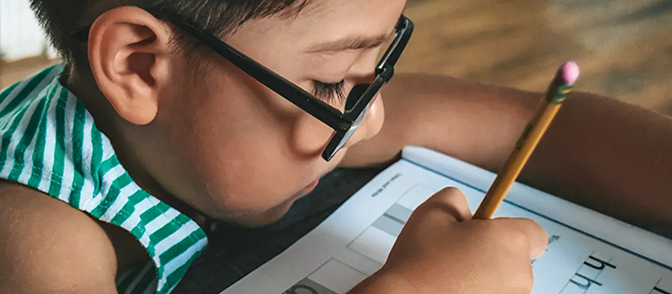
How to Use Italic Handwriting Book D
- Three pages a week is a steady pace. At three pages per week, the book's 88 pages fit into a typical school year with room for breaks. More is fine if your child wants to do more; less is fine if he doesn't.
- Expect more than handwriting on each page. Book D pairs every lesson with language-arts content—capitalization rules, prefixes and suffixes, phonograms, homographs, six forms of poetry, and tongue twisters. Cursive italic practice is still the main work, but the page content is worth reading and discussing with your child.
- Partial pages count. Some third graders work through a full page in one sitting; others split it across two days. Either approach works.
Handwriting today is both a tool for learning and a professional skill. We need a handwriting style that keeps up with the demands of modern life. It needs to be legible and logical, easy to write and easy to learn.
When it comes to being understood, handwriting still matters.
And yet, as authors Barbara Getty and Inga Dubay write, “American handwriting is in a woeful state. We have become a 'please print' nation. But there is hope. We can stop mumbling on paper and become legible writers. We can go italic.”
Keep the focus on learning.
For early learners, literacy and language development are foundations of readiness, and research suggests that handwriting is a key component. Learning to write letters and form words are powerful first steps toward academic success.
A seamless transition.
With the Getty-Dubay Italic Handwriting Series, kids learn one alphabet — basic italic transitions naturally to cursive. In elementary school, handwriting is an important scaffold for basic literacy skills. For middle school students, fluent handwriting means more language arts success, and better preparation for high school.
Publisher's Information
Publisher: Getty-Dubay Productions
Authors: Barbara Getty & Inga Dubay
Age Recommendation: 8-9
Grade Recommendation: 3rd
Faith-Based: No
Consumable: Yes
Pages: 88
ISBN: 9780964921573
Format: Softcover
Copyright: 1994
Made in: USA
 Awards and Endorsements from:
Find answers to the most frequently asked questions about this product below:
Shorter, meaningful, and regular practice is better than longer and/or sporadic sessions. For students in 3rd to 6th grade, we recommend 60-120 minutes per week (12-24 minutes per day).
Some general recommendations:
- Plan on practicing no more than a page at one sitting.
- Spend some time during practice doing some self-assessment. Encourage the student to choose which letters (or joins) they did well, have them mark them and try to replicate those. Ask them to choose which ones they feel do not match the model and therefore need a mental plan (e.g. “I want the ‘h’ ascender downstroke to be straighter”.)
- Put practice to use as soon as you can. For instance, try to avoid asking them to practice a single letter over and over.
- While you might be tempted to jump around in the book, we suggest going page by page, reading all the material as you go.
- Do start with the “Pre-Test” sample of your student's current handwriting. It will be important to see how your student's handwriting has changed over time when the book is finished and the student does the “Post-test".
While you may experience improved handwriting after just a few sessions, most gains will come from repeated practice over time. Handwriting is a lifelong skill built up over many years of study. As you use the workbook, encourage the student to try out your new handwriting on other school work, especially spelling and vocabulary lists, writing short compositions, thank you notes, and other correspondence.
Print / Basic / Manuscript: Writing with no letter joins. Some systems call their printing "ball and stick."
Cursive / Script / Longhand: Writing with joined letters. Used to increase the speed and ease of writing by limiting the number of times one lifts the pen or pencil from the paper.
Serif: An addition to the letter used in cursive writing to initiate the join.
Letterform: The path the writing tool takes to form the letter, numeral or punctuation.
Calligraphy: Literally means "Beautiful writing". Used for formal correspondence, presentations, or artwork. Not intended to be written quickly. Tools: edged pen and ink (either felt, cartridge or dipped), or brush.
Handwriting: Everyday writing used for communication and notes, often with the necessity for speed and legibility. Tools: pencil, felt-tip or ball-point pen, crayon, etc.
The Getty-Dubay Italic Handwriting Series is a developmentally appropriate course that starts with Book A, is designed for use in Kindergarten, and progresses by grade through Book G. Each book supports the motor skill, attention span, and content level of its respective grade level.
If your student needs remedial handwriting work, it is best to use that Getty-Dubay Italic book that matches the student's language skill. For example, an 8th grader who needs help with basic italic would probably be happier using Book G, instead of going back to Books A or B.
Here are a few ideas you can try with your son:
- 1Practice on blank paper with large felt pens. These come in a variety of bright and stimulating colors.
- 2Write with crayons.
- 3Write his letters in sand or cornmeal.
- 4Have him lay a jump rope down in the shape of the letters and make a game of hopping around the letters.
- 5Ask him to try using letterforms in drawings (e.g. lots of n's for house shingles, w's for hair, etc.) Find opportunities to help him make the letters and have fun at the same time.
Ask the child to look at the letter and tell you how it's different from the model. Is it wider, taller, thinner, smaller? Are the letters further apart than the model? Never, ever use the word "wrong." It is simply different from the model.
Encourage the child to assess his/her own writing, with your guidance.
Our books useful no matter with which hand you write. One way this is true is that where possible the page content is arranged carefully so that your writing hand does not cover up the handwriting model you are copying. For left handers we recommend having your wrist below the line of writing and slanting the paper down to the right — in other words, a slight turn in the clockwise direction. Having good over-all posture and enough space for comfortable movement of your arm are also important for a good handwriting experience.
For parents of left-handed children: Left-handedness is perfectly natural, but does present some challenges in our right-handed-centric world. The good news is that, with encouragement, left-handed writers do find ways to adapt. Never insist that the student change writing hands.


- July 17, 2023
Great Practice
Megan G.
I love that I can give this to my son and he can work through a page or two by himself while I work with my other kiddos. Really like the practice for him!
- March 19, 2019
Italic Handwriting Book D Grade 3
AB
My daughter has been able to work through this book on her own. It is fun to watch her incorporate aspects of cursive into her everyday writing as she is learning them.
- May 19, 2015
Different than the norm, but nice
Liz M.
I was intrigued by the simplicity of this cursive method, and I'm glad we tried it. It definitely looks different than what my 8 year old daughter's friends are learning in public and private school since it has less loops and fancy letters. It's actually how I write as an adult - a blend of cursive and print, dropping the fancy loops as it took more time and felt unnecessary. She loves the way it looks and now prefers to write in cursive over print!
- December 31, 2013
I like this book
katie.smithwilson
My older 2 children were only taught to write their first name in cursive and I find that it is very important for kids to learn this! My son seems to enjoy it so far as he likes to do things the other kids have not. He enjoys learning new ways of writing and we are just starting so I cant wait to see what he gets done.
- September 26, 2011
Motivated my daughter
Christie
We'd started with another program with my son and automatically used it for my daughter. What worked for him (and I still love and use for my other boys) wasn't motivating my daughter who appreciates aesthetics. My cousin who was taught Getty-Dubay in public school in the 80s has lovely handwriting, so I bought Getty-Dubay Italics for my daughter. From the start, her handwriting improved because she took her time and enjoyed how pretty it is becoming. The workbook pages are pretty full, with many lines to complete but I only have her do one page per day with her best efforts. We sped through the first book, since she knew how to write already but we went back to the beginning to form letters the italics way. Now she is in the grade level book, and her italic cursive is really nice.
- November 5, 2008
We have used Italic Handwriting for 17+ years!!
Mary S.
We have used Italic Handwriting for years (17 and counting) on Timberdoodle's initial recommendation. People have always commented on how neat our children's handwriting is. It is very legible and moves into calligraphy easily with a chiseled marker. My older children complained a little that their friends and relatives were writing a different way so, after they were proficient at italic cursive, we went over conventional cursive and I told them they were free to adjust their handwriting if they liked. I have liked the results of Italic Handwriting and we are continuing to use it with the rest of our 11 children. A benefit to teaching it is that I have improved at calligraphy myself.
- November 3, 2008
My son LOVED it!!
Michelle L.
My oldest son was resistant to learning cursive. Someone suggested letting him try calligraphy. It made me remember the information I had read about Italic Handwriting in the Timberdoodle catalog. We switched over to italic manuscript and then the transition to italic script was painless. My son LOVED it and his handwriting improved greatly. I also find using the program helpful for my other son who is dyslexic. He can work very independently and the lessons are short.
- October 24, 2008
Used this series with eight children!
Kellyanne E.
I have been using this handwriting program for almost 20 years. I have used it with eight children (so far!) and I have been very pleased with the results. The children have been able to use the books without difficulty (or tears, a big plus). Some of my children have really made the effort to duplicate the beautiful handwriting in the books and have even been inspired to try the calligraphic hand taught in book G. Some of my children have not been as eager to emphasize their handwriting to that degree. However, even those who took the "only what is required" attitude, have fine, legible handwriting.